Do Any of These Sound Familiar?
Managers avoid difficult performance conversations until problems escalate.
Feedback is inconsistent—or doesn't happen at all.
Employees aren't clear about expectations or accountability.
Managers keep coaching without knowing when it's time to take formal action.
HR gets pulled into problems that could have been addressed much earlier.
Your Managers Don't Need More Theory.
They Need a Clear Way to Act.
The Manager Performance Accelerator is designed to help managers handle real performance situations with greater confidence and consistency. Instead of avoiding issues, over-coaching, or immediately handing problems to HR, managers learn a practical approach they can use in everyday conversations with their teams.
Feedback
Give clear, timely feedback employees can act on.
Accountability
Set clear expectations and follow through consistently.
Coaching
Know when to coach—and when coaching isn't enough.
Difficult Conversations
Address problems directly and constructively.
Performance Action
Know when an issue requires documentation or formal action.
A 4-Week System
for Managing Performance With Confidence
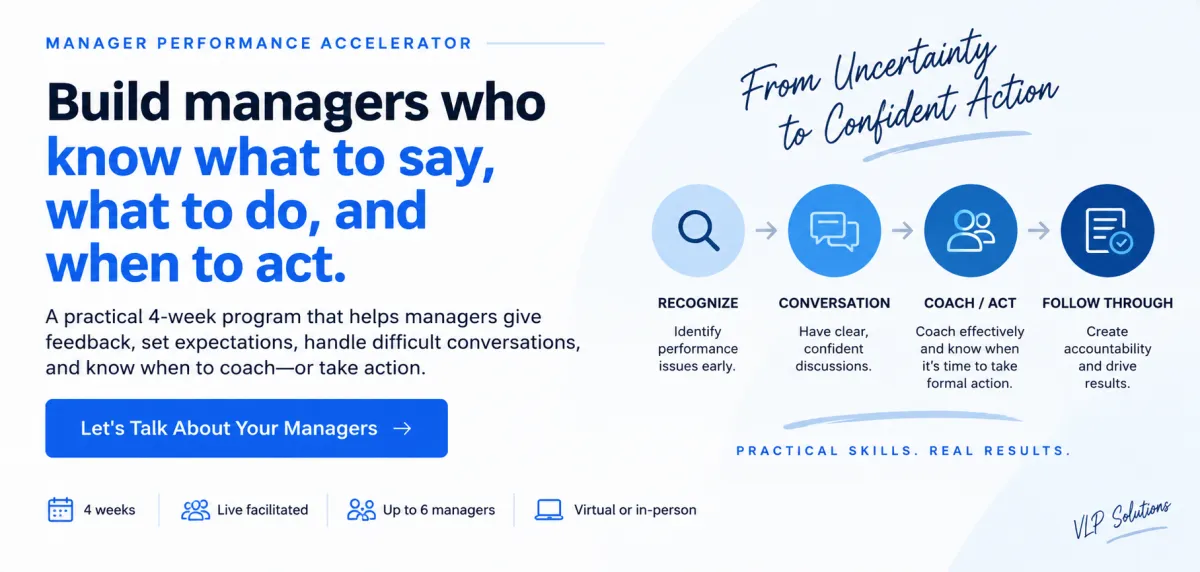
Over four weeks, managers learn how to recognize performance problems, have the conversation, decide when to coach or escalate, and follow through.
WEEK 1
Recognize & Address Performance Problems
Identify the actual performance gap, distinguish skill, will, and resource issues, and address problems before the annual review.
WEEK 2
Have the Difficult Conversation
Give clear feedback, set expectations, handle defensiveness, and leave the employee knowing exactly what needs to change.
WEEK 3
Coach, Document, or Escalate?
Learn when continued coaching makes sense—and when it doesn't. Build skills in documentation, accountability, follow-up, and moving toward formal corrective action or a PIP when appropriate.
WEEK 4
Make Performance Management Stick
Strengthen follow-up, accountability, and measurement while avoiding common manager mistakes and creating greater consistency across the management team.
Training Ends.
The Tools Stay.
Every manager leaves with a practical toolkit they can use long after the four-week program ends—giving them a repeatable system for future performance conversations, not just today's challenge.
Performance Gap Diagnostic
CLEAR Conversation Framework
Difficult Conversation Planner
Performance Response Matrix
Performance Conversation Record
PIP Readiness Checklist
Accountability Action Plan
Program at a Glance
4 WEEKS
One focused session weekly
110-MINUTE SESSIONS
Live facilitated sessions each week
UP TO 6 MANAGERS
Per cohort
FLEXIBLE DELIVERY
Virtual or in-person
What Changes After Four Weeks?
Managers leave with more than information. They leave knowing how to recognize performance issues earlier, have clearer conversations, make better decisions about when to coach or escalate, and follow through consistently.
MORE CONFIDENT MANAGERS
Know what to say and how to address performance issues instead of avoiding
CLEARER PERFORMANCE EXPECTATIONS
Managers set expectations, address gaps, and follow through more consistently.
FEWER ISSUES ESCALATING TO HR
Managers address performance issues earlier—before they become larger employee-relations problems.
Is This the Right
Fit for Your Managers?
The Manager Performance Accelerator is designed for organizations with managers responsible for employee performance who could use additional support with feedback, accountability, difficult conversations, and performance concerns.
Built From Real-World Experience
Developed by VLP Solutions, the Manager Performance Accelerator is grounded in real-world experience across leadership development, performance management, training, onboarding, and organizational change.
REAL-WORLD EXPERIENCE
Leadership and training experience across corporate, government, military, and small-business environments.
PRACTICAL, NOT THEORETICAL
Training is built around conversations, decisions, and performance situations managers actually face.
BUILT FOR APPLICATION
Managers practice the skills during the program and leave with tools they can continue using afterward.
Practical. Interactive.
Built for Real Managers.
LEARN
A practical approach managers can use immediately.
PRACTICE
Work through realistic performance scenarios and difficult conversations.
APPLY
Use the tools on the job and bring real challenges back for discussion.